Introduction
Choosing a college shapes career trajectory, financial stability, and personal growth for years ahead. For most Indian students and families, the process quickly becomes overwhelming. Over 1.33 million Indian students were pursuing higher education abroad as of January 2024, according to the Ministry of External Affairs — and that number keeps climbing.
The challenge isn't a shortage of information. It's the opposite: conflicting rankings, peer pressure, parental expectations, and a flood of opinions make it easy to make the wrong choice for the right-sounding reasons.
This blog lays out a clear, 7-step framework, from initial self-reflection to a confident final decision, to help students filter out the noise and find the institution that genuinely fits them.
Key Takeaways
- The best college isn't the most prestigious one — it's the one that aligns with your goals, budget, and personal fit.
- Start the process at least 18–24 months before intended enrolment.
- Programme-level strength and career outcomes matter more than overall university rankings.
- Building a balanced list of safety, target, and reach schools protects your options and keeps multiple paths open.
- Professional guidance can accelerate the process and significantly improve application quality.
Steps 1 and 2: Start With Yourself
Most students make the same foundational mistake: they start researching universities before they have any clarity on what they actually need. The result is a college list built on brand recognition and peer influence rather than personal fit. These first two steps fix that.
Step 1: Reflect on Your Academic Interests, Strengths, and Career Goals
Begin with a genuine self-assessment: where do your strongest academic results overlap with the subjects you'd willingly study beyond a syllabus?
Ask yourself:
- Which subjects do you consistently perform well in and enjoy?
- What extracurricular activities have held your attention for more than one year?
- Are there professionals in specific fields whose careers genuinely appeal to you?
If you're undecided on a major, that's useful data — it means you should prioritise universities with flexible curricula, strong interdisciplinary programmes, or liberal arts structures that let you declare later.
Practical exercise: Review your academic results from the last two years, list your top three extracurricular involvements, and speak to one or two professionals in fields you're considering. Ask them what a typical week looks like — that single question tends to cut through abstract appeal faster than any career quiz.
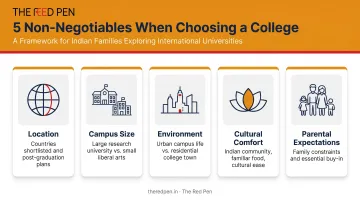
Step 2: Define Your Non-Negotiables
Once you have some self-awareness, translate it into concrete parameters. These become the filter through which every university gets evaluated.
Consider:
- Location — Which countries or cities are genuinely viable? Does your family expect you to return to India after graduation, or are you open to staying abroad?
- Campus size — A large research university (30,000+ students) and a small liberal arts college offer fundamentally different experiences.
- Environment — Urban campus with city access, or a residential campus-town setting?
- Cultural comfort — For Indian students specifically, proximity to an Indian student community, vegetarian food options, and cultural familiarity are legitimate preferences, not afterthoughts.
- Parental expectations — Be honest about what constraints exist at home. A university that requires significant parental buy-in won't work if that buy-in isn't there.
Name these non-negotiables early. They'll save you significant time when you start building your shortlist.
Steps 3 and 4: Research Programmes and Understand the Financial Reality
This is where research replaces reflection. You're moving from general preferences to a specific, evidence-based college list. When you approach this phase properly, it protects you from uninformed decisions and expensive surprises.
Step 3: Evaluate Academic Programmes and University Reputation
Here's a critical distinction that most students miss: overall university rankings are a starting point, not the verdict. A university ranked 50th globally may have a top-10 programme in your intended field. What matters is the strength of the specific department you'll spend four years in.
When evaluating any programme, investigate:
- Faculty credentials and research output — are professors active researchers whose expertise aligns with your interests?
- Course structure — check whether the curriculum matches your goals, or whether it's too broad or too narrow for your intended specialisation.
- Industry connections — internship pipelines, co-op programmes, and corporate partnerships built into the degree matter more than brochure language.
- Accreditation — This is non-negotiable for professional fields. ABET accredits engineering and computing programmes; AACSB accredits business degrees. For Indian students, check whether the Association of Indian Universities (AIU) recognises the foreign degree for domestic employment or further study — a programme's international reputation does not automatically translate to Indian recognition.
U.S. News & World Report's programme-specific rankings go far deeper than composite global tables, offering subject-level data that reflects actual departmental strength. The Red Pen's partnership with U.S. News & World Report gives students direct access to this deeper intelligence when building their shortlist — moving the conversation beyond headline rankings to the data that actually affects your experience and outcomes.
For Indian institutions, NIRF rankings evaluate universities across Teaching & Learning, Research, Graduation Outcomes, Outreach, and Perception — a useful comparative framework alongside international options.
Once you have a realistic programme shortlist, the next question is equally practical: can you afford it, and does the investment make sense?
Step 4: Map Out the Full Cost of Attendance and Your Funding Options
Sticker shock is real, and it catches families off guard when they focus only on tuition. Full cost of attendance includes tuition, housing, food, health insurance, books, and personal expenses — for US private universities, that total currently exceeds USD 62,000 per year.
Annual cost benchmarks (2024–25):
| Option | Approximate Annual Cost |
|---|---|
| US public university (out-of-state) | USD 49,080 |
| US private nonprofit university | USD 62,990 |
| UK international undergraduate | GBP 11,400–38,000 tuition + GBP 900–1,400/month living costs |
| Ashoka University (India, UG) | INR 12,90,400 |
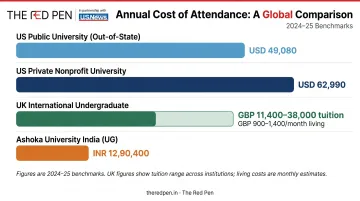
Source: College Board Trends in College Pricing 2024; British Council; Ashoka University.
Beyond the numbers, think through:
- Funding options — Merit scholarships, need-based grants, IBA Model Educational Loan Scheme, and on-campus work opportunities. Understand the realistic debt load each path implies.
- ROI — Does the post-graduation salary in your chosen field and intended country of work justify the total investment? NACE's Class of 2024 data reports 85.7% career outcomes for US bachelor's graduates, with a mean starting salary of USD 66,505. UK first-degree graduates in full-time employment earn a median of GBP 30,000. If you plan to return to India, research salary benchmarks in your field there — the earnings picture shifts considerably.
- Currency risk — A weakening rupee increases the effective cost of a foreign degree over time. Build that into your financial planning.
One clear caution: prestige does not offset unmanageable debt. A highly ranked university that requires significant private borrowing without a realistic repayment plan is a poor choice, not a bold one.
Steps 5, 6, and 7: Evaluate, Compare, and Commit
You now have a longlist. This phase transforms research into judgment by combining direct experience, outcome data, and structured comparison to reach a final decision.
Step 5: Visit Campuses or Attend Open Days and Virtual Tours
No brochure, ranking, or Instagram feed captures what it actually feels like to be on a campus. Students who visit often describe an instinctive pull toward one institution over another and that gut response, informed by prior research, is worth taking seriously.
For international campuses or budget-constrained students, virtual open days are the next best option and should be treated as mandatory, not optional. Universities including Harvard, Oxford, and Manchester offer structured virtual tours and webinars with current students.
Questions worth asking on any visit:
- What support exists specifically for international students?
- What is the average class size in my intended major?
- What do alumni typically do in the first two years after graduation?
- How does the university support student mental health and wellbeing?
Step 6: Assess Career Outcomes, Alumni Networks, and Support Services
A university's value extends well beyond graduation day. When evaluating shortlisted institutions, look specifically at:
- Graduate outcomes — Ask for placement rates by major from first-destination surveys, not just overall figures.
- Alumni networks — A strong alumni community with reach into India's corporate landscape accelerates career entry. Connections to alumni you haven't met yet often open more doors than existing close ties, as Granovetter's weak-ties research established.
- Student support services — Academic advising, mental health resources, and international student offices shape day-to-day experience. Confirm these remain accessible during semester breaks, when Indian students are often still on campus.
Career value comes from programme outcomes, alumni reach, work authorisation rules in your target country, and on-campus support quality. Rank alone doesn't tell that story.
Step 7: Build a Balanced List and Make Your Final Decision
Apply the safety/target/reach framework when finalising your application list:
- Safety schools — Your profile comfortably exceeds typical admission requirements, making acceptance highly likely
- Target schools — Your profile is competitive and you have a genuine, realistic chance of admission
- as prolonged indecision rarely leads to a better choice.
Note for Indian students: A school is not truly "safe" if admission is likely but financial aid is not. Include financial viability in your safety classification from the start.
How The Red Pen Can Help
For students navigating this process for the first time — especially those applying to international universities from India — the volume of information, decisions, and deadlines can feel genuinely unmanageable.
The Red Pen is a Mumbai-based admissions consulting firm offering end-to-end undergraduate support from initial profile analysis through final university selection. The team includes graduates from Oxford, Cambridge, Stanford, Columbia, and Duke, and holds membership in IACAC (International Association for College Admission Counseling). Students across India are served through online delivery.
What distinguishes The Red Pen's approach:
- Builds balanced dream/target/safety shortlists tailored to each student's academic profile, goals, cultural preferences, and financial reality — not generic rankings
- Uses the INK (Interactive Narrative Kit), a proprietary essay framework that guides students from blank page to a personalised application narrative across all written components
- Provides programme-level university data through a strategic partnership with U.S. News & World Report, supporting more informed shortlisting decisions
- Offers dedicated Oxbridge and Ivy League preparation, including specialist interview coaching led by team members with firsthand Oxford admissions experience
- Has helped students secure significant scholarships and financial aid through a counselling team with thousands of applications supported globally

Students can book a free initial consultation at theredpen.in or reach the team at +91 98204 91179.
Conclusion
The right college isn't the most recognised name on a global ranking. It's the institution where your academic interests, career ambitions, financial situation, and personal preferences intersect most strongly.
Students who make the best college decisions treat the process as a structured exercise in self-knowledge and research — not a last-minute scramble driven by peer pressure or parental anxiety. Start early, be honest about what you actually need, and use data to validate your instincts.
The 7 steps in this guide give you the framework. The students who navigate it best aren't necessarily the most accomplished — they're the most intentional.
If you're working through this process and want structured support — from college list building to application strategy — The Red Pen works with students across India to make each of these decisions with clarity and purpose.
Frequently Asked Questions
How to choose the best college or university?
The best college aligns with your programme interests, financial capacity, and career goals — not simply the highest-ranked option on a global list. Validate your shortlist with outcome data and direct engagement through open days or virtual visits.
Should I choose a college or a university?
Colleges typically focus on undergraduate teaching across a narrower subject range, while universities offer broader programmes, postgraduate degrees, and research facilities. The credential awarded and its accreditation matter more than the institution's label.
How many colleges should I apply to?
A balanced list of 8–12 institutions spread across safety, target, and reach tiers is advisable for Indian students applying internationally. Quality matters more than volume — strong applications to 10 schools outperform mediocre ones sent to 15.
What is the most important factor when choosing a university?
Programme strength and career outcomes consistently matter more to long-term success than overall prestige or campus aesthetics. Financial viability is equally critical — a prestigious offer you cannot sustain financially is not a good offer.
How do college rankings help in choosing a university?
Rankings are a useful starting point for discovery, not a final verdict. Programme-specific rankings and graduate outcome data are more meaningful than composite global rankings — a university ranked 50th overall may have a top-10 department in your intended field.
When should I start researching colleges and universities?
Begin at least 18–24 months before intended enrolment — ideally in Grade 10 or 11. The US College Board advises starting your college list no later than Grade 11 to allow adequate time for research, test preparation, and application planning.