
Introduction
Building a college list feels deceptively simple — until April arrives and strong applicants find themselves with no viable offers. The process demands more structure, self-awareness, and strategic thinking than most students expect going in.
India is now the leading place of origin for US international students, with over 363,000 students enrolled in 2024–25. At the undergraduate level alone, that figure reached 36,053 in 2023–24 — a 12.8% increase year on year. Acceptance rates at selective universities have continued to fall even as the Indian applicant pool grows.
With more Indian students competing for the same seats, a weak list structure is increasingly costly. Many students still start by scrolling rankings, shortlisting familiar names, and reverse-engineering a strategy from there. That approach rarely produces a list that is balanced, financially realistic, or suited to where a specific applicant will thrive.
This guide walks through how to self-assess, what factors to evaluate, how to categorise schools, and which mistakes consistently derail otherwise strong applications.
Key Takeaways
- A strong college list is balanced and personalised — not a collection of famous names
- Begin with honest self-assessment before opening a single university website
- Aim for 10–14 schools across reach, target, and safety categories
- Fit, affordability, and post-graduation outcomes matter more than name recognition
- Start exploratory research in Grade 10; finalise your list before the summer before Grade 12
Why Your College List Should Start With Self-Assessment
Most students build their lists in the wrong direction. They start with a ranking, identify the top 20 schools, and then try to justify each choice retroactively. The result is a list that reflects what looks impressive rather than what fits.
Before visiting a single university website, answer these questions honestly:
- Academic environment: Do you perform best in large lecture-based settings or smaller seminar classes?
- Programme clarity: Do you have a clear intended major, or do you need a flexible curriculum that allows exploration?
- University type: Are you drawn to large research universities with extensive resources, or smaller liberal arts colleges with closer faculty relationships?
- Post-graduation goals: Are you targeting employment immediately after graduation, research, or graduate school — and does your shortlist reflect those paths?
The Financial Conversation You Cannot Skip
For Indian families, this conversation must happen before shortlisting begins. According to the College Board's 2025 Trends report, the average total annual budget at a private nonprofit university in the US now exceeds $65,470 (approximately ₹55 lakhs), including tuition of $45,000 and housing of $15,920. At public universities for out-of-state students, the figure is $50,920 (approximately ₹42 lakhs).
Factor in travel home, visa costs, and currency fluctuation over four years — and the actual commitment is significant.
International students are generally not eligible for US federal financial aid. This means understanding which schools offer merit scholarships or need-based aid to internationals needs to shape the list from day one — not after acceptances arrive.
Many families treat budget as a filter applied after offers arrive. At The Red Pen, financial planning comes first — counsellors work through a family's budget before any school names go on the list.
How to Build Your College List: Step-by-Step
Building a college list that actually works comes down to five stages: define your priorities, generate a longlist, research thoroughly, categorise by tier, and narrow to your final list. Each step builds on the last — skipping ahead tends to produce lists that look thorough but fall apart under scrutiny. Here is how each stage works.
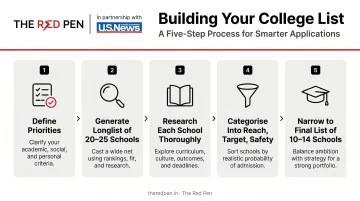
Step 1: Define Your Academic and Personal Priorities
Document your non-negotiables — things you will not compromise on — separately from your preferences, which are desirable but flexible.
A few examples of how different priority combinations lead to very different lists:
- A student who needs financial aid, a strong computer science programme, and urban location will look at a very different set of schools than one who prioritises small class sizes, flexibility to explore majors, and a rural campus community.
- A student targeting pre-med with research opportunities will prioritise universities with strong biology departments, affiliated teaching hospitals, and undergraduate research access — regardless of overall ranking.
- For a student focused on early employment in finance, internship pipelines, proximity to financial centres, and alumni networks in banking matter far more than they would for someone planning to apply to PhD programmes.
Step 2: Generate an Initial Longlist of 20–25 Schools
This phase is exploratory. The goal is breadth, not judgement — no school should be removed yet.
Useful discovery tools include:
- College Board BigFuture — searches 4,300+ colleges with filters for major, location, acceptance rate, and GPA range
- Common App Explore — covers 1,000+ member institutions with application requirements, virtual tours, and campus life details
- NCES College Navigator — official US Department of Education data on costs, enrollment, and programme offerings
- Subject-specific rankings (QS by subject, US News by programme area) for domain-level research
- The Red Pen's counsellors, who draw on direct campus visit experience and established admissions officer relationships to surface institutional details that databases alone cannot capture
Step 3: Research Each School Thoroughly
Superficial research produces poor shortlisting decisions. Thorough research means:
- Reviewing the university's Common Data Set (available on institutional research pages at Harvard, MIT, Yale, Princeton, and most major universities) for acceptance rates, middle 50% test score ranges, and enrollment data
- Reading the official admissions profile and class statistics
- Watching campus tour videos and attending virtual information sessions
- Reviewing student-authored accounts on forums and alumni platforms
- For Indian applicants specifically, understanding how a university evaluates international students — The Red Pen's counsellors can speak to this directly, drawing on campus visit history and ongoing admissions officer relationships
Step 4: Categorise Schools Into Reach, Target, and Safety
Each school on the longlist should be assessed against the student's academic profile — test scores, GPA, predicted grades, extracurriculars — and placed into one of three tiers. This is covered in depth in the next section.
Step 5: Narrow to a Final List of 10–14 Schools
Every school that survives to the final list needs a clear, specific reason for being there — not just name recognition. Ask: would you genuinely enrol here if it were your only offer?
If the answer is no for any school — including a safety — it should not be on the list. Two quick checks before finalising:
- Genuine interest test: Could you write a specific, convincing "Why this school?" essay for each one?
- Enrolment test: Would you attend without hesitation if it were your only offer?
Essays and demonstrated interest reveal performative engagement quickly, and admissions officers can tell the difference.
Key Factors to Evaluate When Shortlisting Colleges
Academic Offerings and Programme Fit
Verify that your intended major exists — and then go further. Research whether the department has:
- Active faculty publishing in your area of interest
- Undergraduate research or honours thesis opportunities
- Internship pipelines or co-op programmes
- Dual-degree or interdisciplinary options if you want flexibility
Department-level research matters more than overall ranking for most applicants.
Location and Financial Fit
Location shapes daily life: urban campuses offer internship access and cultural variety; rural campuses offer community and lower cost of living. For Indian students, proximity to a South Asian community can meaningfully affect comfort and belonging — worth factoring in.
Beyond location, cost is a non-negotiable variable — especially since international undergraduates cannot access US federal student aid. Focus your financial research on:
- Need-based institutional aid — a small but important group of universities (Harvard, Princeton, MIT among them) meet 100% of demonstrated need for international students
- Merit scholarships — available at many universities and awarded based on academic achievement, test scores, and extracurricular profile
- Net price calculators — available on most university websites and essential for any school where cost is a genuine constraint
Post-Graduation Outcomes for Indian Students
Research graduate employment rates and average starting salaries in your intended field. For Indian students on F-1 visas, check whether universities offer:
- OPT — standard 12-month post-graduation work authorisation
- STEM OPT extension — an additional 24 months for graduates of STEM-designated programmes
Indian students accounted for 48% of all STEM OPT participants in 2024, reflecting how critical programme-level STEM designation has become for post-graduation planning.
How to Balance Reach, Target, and Safety Schools
Understanding Each Tier
| Category | Admission probability | Definition |
|---|---|---|
| Reach | Below 20–25% | Highly selective; outcome is genuinely uncertain regardless of profile strength |
| Target | 30–60% | Well-matched to academic profile; admission is realistic but not guaranteed |
| Safety | Above 65–70% | Student is clearly above the median admitted applicant |
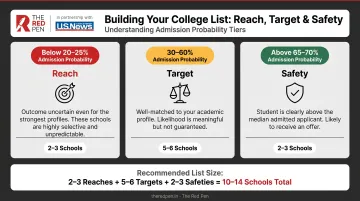
A workable distribution for a list of 10–14 schools: 2–3 reaches, 5–6 targets, 2–3 safeties.
What Makes a School a True Reach
MIT's 2024–25 admit rate was 4.55%. Yale's was 3.87%. At these institutions, even applicants with near-perfect profiles are rejected. Holistic review, institutional priorities around geographic and demographic diversity, and sheer volume of qualified applicants make outcomes genuinely unpredictable. No school should be treated as a guaranteed admission.
What a Safety School Actually Means
A safety is not a consolation. It is a school where:
- Your academic profile is clearly above the median admitted student
- You would genuinely be happy to attend and thrive
- The financial outcome is feasible for your family
Adding schools to inflate a list without genuine interest works against you. Essays reflect engagement — or the absence of it.
Demonstrated Interest and Strategic Application Choices
Some universities track campus visits, virtual session attendance, email engagement, and Early Decision applications as signals of genuine interest. For Indian students applying from abroad, practical ways to demonstrate interest include:
- Attending virtual information sessions and asking specific questions
- Following up with admissions officers after college fairs
- Applying Early Decision or Early Action where appropriate and where it makes strategic sense
Beyond demonstrated interest, application timing itself is a strategic lever. Early Decision historically produces notably higher admit rates at institutions that offer it. Because ED carries a binding commitment, it works best when the financial picture is clear. The Red Pen's counsellors work through these trade-offs with students across their full list, helping them identify where ED strengthens an application and where it doesn't make sense.
Common Mistakes to Avoid When Building Your College List
Relying Too Heavily on Rankings
Rankings measure a specific and limited set of institutional metrics — research output, peer reputation, faculty resources. Research cited by Inside Higher Ed found no correlation between institutional selectivity and student learning or future job satisfaction. The US News methodology itself acknowledges that score differences in the middle of rankings may be statistically insignificant.

Rankings are one data point. They tell you nothing about whether a university's teaching style, campus culture, or financial aid policies are right for you.
Creating a Top-Heavy List
Applying to 12 schools where 10 are reaches provides no real safety net. Even strong applicants are rejected from highly selective universities — that is not a failure of the application, it is a feature of how those admissions processes work. A list without genuine target and safety options forces a gap year or re-application cycle.
Skipping Research and Relying on Word-of-Mouth or AI Tools
Peer recommendations and AI-generated suggestions can be useful starting points for discovery. But they cannot replace primary source research, which includes:
- The university's Common Data Set and official admissions profile
- Institutional financial aid policies for international applicants
- Acceptance rate trends for students from India
Every student's profile is unique. A school that worked for a classmate may be a poor admissions fit for you, even with similar scores — different extracurriculars, essay angles, and institutional priorities all shift the picture significantly.
Frequently Asked Questions
How do I create the perfect college list?
There is no single perfect list, but a well-built one starts with honest self-assessment, includes schools across all three tiers, and ensures every school is one you would genuinely be glad to attend. Getting the balance right across reach, target, and safety schools matters more than hitting a specific number.
How many colleges should I apply to?
For most students, 10–14 schools is a practical range: enough to cover reach, target, and safety categories without spreading application effort so thin that quality suffers across every submission.
What is the difference between a reach, target, and safety school?
Reach schools are highly selective with uncertain outcomes even for strong applicants. Target schools align well with your academic profile and represent realistic admits. Safety schools are those where admission is highly likely and you would still be genuinely happy to enrol.
When should Indian students start building their college list?
Begin exploratory research in Grade 10, start serious shortlisting in Grade 11, and have a finalised list before the summer before Grade 12. This timeline allows full focus on applications and essays during the critical senior year period.
Should I prioritise rankings when choosing where to apply?
Rankings are one data point among many. Academic programme fit, financial viability, post-graduation career outcomes, and personal fit are more meaningful indicators of whether a university is right for you than its position in any particular table.
Can I use AI tools to help build my college list?
AI tools can be useful for initial discovery, such as generating school names to investigate or questions to ask during research. They should not replace primary source research from official university websites, Common Data Sets, or experienced counsellors who understand how specific institutions evaluate international applicants.