Introduction
According to MEA data, over 1.33 million Indian students studied abroad in 2024 — making India one of the world's largest sources of international students. Canada, the US, the UK, Australia, and Germany top the destination list. Yet in 2025, that number dipped by 5.7%, partly because students and families discovered — too late — that the process is far more demanding than anticipated.
Generic study abroad guides won't cut it for Indian applicants. The challenges here are specific:
- Education loans with collateral requirements and co-borrower conditions
- Apostille documentation from the Ministry of External Affairs
- Foreign remittances governed by RBI's Liberalized Remittance Scheme
- Competitive applicant pools at global universities
- Balancing family expectations alongside academic ambitions
This guide addresses all of it: planning timelines, financial strategy, visa documentation, country selection, and adjusting to life abroad.
Key Takeaways
- Start planning 12–18 months before your target intake; top university deadlines arrive faster than most Indian students expect
- Financial planning should cover education loans, LRS remittance rules, forex cards, and scholarship applications — all at once
- Documents like apostille certificates and police clearance certificates take weeks; start gathering them early
- Choose your destination based on post-study work rights, cost of living, and degree recognition back in India
- Building routine and community early abroad leads to stronger academic performance over time
Start Early: How to Plan Your Study Abroad Journey
Most Indian students underestimate how far ahead global universities expect applications. UCAS deadlines for Oxford, Cambridge, and medicine courses fall in October of the year before enrollment — UBC's 2026 cycle closed in January. US institutions run their own timelines, with many Early Decision rounds closing in November, over a year before classes begin.
Add those windows together and the picture becomes clear:
A realistic planning window is 12–18 months minimum.
Build Your Testing Timeline First
Standardized tests anchor everything else. Here's what to know:
- IELTS / TOEFL — scores valid for 2 years; TOEFL requires a 3-day gap between attempts
- GRE — valid for 5 years; retakes allowed every 21 days, up to 5 times in a rolling 12 months
- GMAT — valid for 5 years; minimum 16 days between attempts
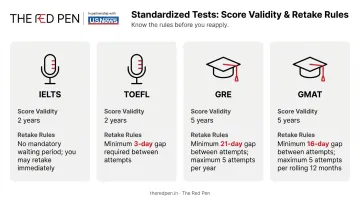
Book your first test date early enough to allow at least one retake before application deadlines. Many Indian students discover their target score requires a second attempt — and there's rarely time to fit one in if you've started late.
Shortlisting the Right Programmes
Rankings give useful context, but subject-level tables and outcome data often matter more. QS, THE, and US News each use different methodologies — QS weights reputation and employer surveys heavily, while THE emphasises research output — so the same university can sit very differently across lists.
Look beyond the league table at:
- Graduate employment outcomes and industry partnerships
- Whether the degree is recognised by Indian employers or regulatory bodies in your field
- Faculty research areas that match your academic interests
- Cost relative to your financial plan
Building a Competitive Application
Indian applicants compete in large, concentrated pools — especially at universities popular with the Indian diaspora. Your academic transcript matters, but so does everything else:
- Statement of Purpose / Personal Statement — must articulate a specific, credible academic and career narrative, not generic ambition
- Letters of Recommendation — choose recommenders who can speak to concrete achievements, not just grades
- Extracurriculars — quality and coherence of activities outweigh volume
This is where structured support makes a real difference. The Red Pen works with Indian students across all of this — college list building across the US, UK, and Canada, essay coaching, mock interviews, and post-submission guidance. Students from Grade 9 onwards can start with their Undergraduate Preparation service for early profile building. Book a consultation or call +91 98204 91179.
Financial Planning for Indian Students Studying Abroad
Tuition is just the beginning. Realistic financial planning covers four layers: total cost of attendance, how to fund it, how to move money efficiently, and how to reduce what you owe through scholarships. Start with the numbers:
Here are realistic annual cost benchmarks across the top five destinations for Indian students:
| Destination | Approximate Annual Cost Range |
|---|---|
| USA | USD 21,000–65,000 (tuition + living; use your university's I-20 estimate) |
| UK | GBP 11,000 tuition + GBP 8,000–11,000 living costs |
| Canada | CAD 16,000–25,000 tuition (college diploma level); living costs additional |
| Australia | AUD 20,000–50,000 tuition + AUD 29,710+ living costs |
| Germany | EUR 70–430/semester contribution + EUR 900–1,200/month living costs |
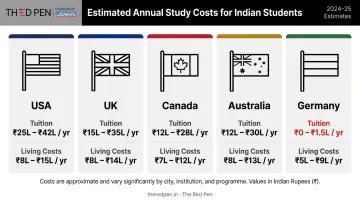
These are benchmarks. London, New York, and Sydney cost significantly more than national averages suggest.
Once you have a cost estimate in hand, the next step is figuring out how to fund it.
Education Loans: What Indian Students Need to Know
Two broad categories exist:
- Collateral loans — secured against property; typically higher amounts available from nationalised banks like SBI
- Non-collateral loans — unsecured; available from NBFCs like Avanse and Auxilo, and from SBI for select premier institutions up to ₹50 lakh
SBI's Global Ed-Vantage scheme offers loans up to ₹3 crore for overseas study. Eligibility and interest rates depend on the institution, course, and applicant profile — compare across lenders before committing.
Remitting Money Abroad: The LRS Framework
The RBI's Liberalized Remittance Scheme permits Indian residents to remit up to USD 250,000 per financial year for education. From 1 April 2026, education remittances funded from personal savings attract 2% TCS on amounts above ₹10 lakh. Remittances funded through a qualifying education loan attract nil TCS from 1 April 2025 — worth factoring in when planning large transfers.
For day-to-day expenses, three main channels exist:
- Forex cards — rate locked at load time; watch for reload and inactivity fees
- International wire transfers — check both sender-side and correspondent bank charges
- International debit cards — FX markup applies at each transaction; convenient but often costlier
No single option is cheapest in every scenario. Compare the all-in cost for your typical transaction size.
Scholarships Worth Applying For
Reducing what you borrow matters as much as managing how you transfer it. Apply to multiple sources simultaneously — scholarship timelines often overlap with application deadlines.
- National Overseas Scholarship — for SC, Denotified/Nomadic Tribe, Landless Agricultural Labourer, and Traditional Artisan applicants; 125 fresh awards available in 2025–26, family income ceiling of ₹8 lakh
- Chevening Scholarships — UK government–funded; for eligible Indians pursuing a one-year taught UK master's
- DAAD — Germany's academic exchange programme; India was among DAAD's three largest recipient groups in 2024
- Commonwealth Scholarships — India-eligible for select master's and PhD routes
- University merit grants — many top US and UK universities offer need-based or merit aid; check each institution's financial aid page directly
Visa, Documents & Pre-Departure Checklist
India-Specific Documentation Stack
Documentation is where most Indian applicants lose weeks — and sometimes their visa window. Start collecting these early:
- Attested marksheets and degree certificates
- Apostille from the Ministry of External Affairs — e-Sanad handles online apostille where the issuing institution is integrated; others require physical submission through MEA's authorized channels
- Police Clearance Certificate (PCC) — apply via Passport Seva, book a PSK appointment, and carry originals; police verification may be required
- Bank statements and Income Tax Returns (ITR)
Start these at least 3–4 months before your visa application date.
Visa Requirements by Destination
Each destination has its own visa structure, and the financial proof requirements vary significantly. Here's what you need at a glance:
| Visa | Key Requirement | Financial Proof |
|---|---|---|
| US F-1 | I-20, DS-160, SEVIS fee, interview | Funds sufficient for tuition + living (per I-20 estimate) |
| UK Student Visa | CAS from university | GBP 1,529/month in London or GBP 1,171/month outside London, held 28 days |
| Canada Study Permit | DLI acceptance letter, biometrics | CAD 22,895 living costs (from Sept 2025, excluding tuition) |
| Australia Subclass 500 | CoE, OSHC, Genuine Student evidence | AUD 29,710+ living costs, plus tuition and travel |
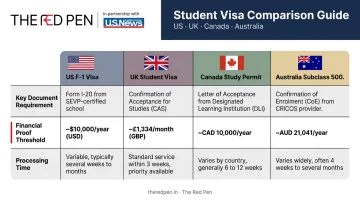
Visa rejections across all destinations most often come down to the same core issues: incomplete documents, insufficient financial proof, or failure to demonstrate genuine student intent. For US visas specifically, Section 214(b) rejections — where applicants cannot prove non-immigrant intent — are among the most common.
Pre-Departure Checklist
Once your visa is approved, the pre-departure phase begins. Before you board:
- Confirm accommodation and have the address in writing
- Activate your forex card and test it with a small transaction
- Notify your Indian bank of international usage to prevent card blocks
- Purchase international health insurance (check if your destination requires it before you arrive)
- Carry vaccination records; some countries require proof of specific immunisations
- Store digital copies of all documents — passport, visa, admission letter, insurance — in cloud storage
- Save emergency contacts: university international office, Indian embassy/consulate, a trusted local contact
Choosing the Right Country and University
No single destination suits every student — the right country depends on your field, budget, career goals, and what you want your life to look like after graduation.
Post-Study Work Rights at a Glance
| Country | Post-Study Work Permission |
|---|---|
| USA | OPT: 12 months; STEM extension adds 24 months |
| UK | Graduate Visa: 2 years (applied by 31 Dec 2026); reducing to 18 months from Jan 2027; PhD graduates get 3 years |
| Canada | PGWP up to 3 years for programmes of 2+ years |
| Australia | Subclass 485: typically 2–3 years depending on qualification |
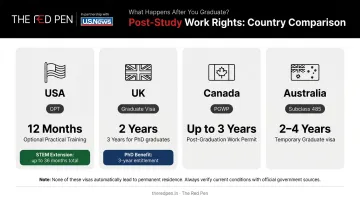
Important: Post-study work visas are temporary. None lead automatically to permanent residence. Canada's Canadian Experience Class requires qualifying skilled work experience gained in Canada — not study time. Australia and the UK both run separate skilled-migration pathways that you'd need to qualify for independently. Build this reality into your planning from the start.
Beyond Rankings: What Actually Matters
Ask these questions before finalising a university:
- What do graduates from this programme actually do? Are employment outcomes published?
- Is the degree recognised by relevant Indian regulatory bodies? The NMC has specific requirements for foreign medical degrees; the Bar Council of India maintains a list of recognised foreign law universities
- Does the alumni network include Indians who've returned home — and are they accessible?
- Is the Indian community in this city large enough to offer support, but not so dominant that you never step outside it?
Common Selection Mistakes to Avoid
- Choosing a country because your neighbour's child went there
- Prioritising a university's brand over the specific programme's quality and graduate outcomes
- Ignoring accreditation status of smaller or newer institutions
- Underestimating cost differences between cities within the same country (Manchester vs. London; Toronto vs. Vancouver)
Thriving Abroad: Settling In and Making the Most of Your Experience
Managing the Cultural Adjustment
Indian students typically move from a collectivist environment — family-centred, relationship-driven — into academic cultures that expect independent thinking, vocal class participation, and a different relationship with authority figures. This shift takes time.
Common early struggles include:
- Homesickness, especially in the first 8–12 weeks
- Navigating academic expectations around seminar participation and independent research
- Understanding plagiarism norms, which are enforced far more strictly abroad than most Indian students are used to
- Building social connections outside the Indian student circle
This is a normal part of adjusting, not a sign that something is wrong. Universities have international student offices, counselling services, and peer support groups — use them early. A 2025 systematic review of 20 studies found that 18.8% of international students showed moderately severe-to-severe depression and 20.6% experienced severe anxiety. Reaching out before things escalate makes a real difference.
Balancing Academics, Work, and Wellbeing
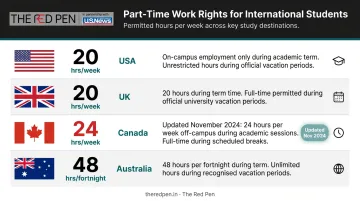
Part-time work is a financial reality for many students. Know the rules:
- USA — 20 hours/week on campus during term; off-campus requires specific authorisation
- UK — 20 hours/week during term; full-time during vacations
- Canada — 24 hours/week during regular terms (rule updated November 2024)
- Australia — 48 hours/fortnight while study is in session
Students who build a structured weekly routine in the first month — fixed study blocks, a regular exercise habit, consistent mealtimes — adapt faster and perform better than those who let the schedule drift.
Turning the Experience Into a Career Asset
Your time abroad builds skills that employers actively look for — but only if you document and articulate them. Start from day one:
- Update your LinkedIn to reflect your international enrolment
- Name the competencies you're building: cross-cultural communication, adaptability, independent problem-solving
- Connect with your university's alumni network, especially Indian graduates who've returned home
- Ask them directly how the degree is perceived in the Indian job market and how to position it on your CV
The Red Pen supports students across the full admissions journey — from early planning and programme selection through application strategy, essay development, and post-submission decisions. If you're at any stage of that process, WhatsApp the team or book an appointment to speak with an expert counsellor.
Frequently Asked Questions
What should I do to study abroad?
Identify your academic and career goals, take required tests (IELTS/TOEFL, GRE/GMAT if applicable), shortlist programmes, prepare your documents and application materials, apply for admission, then secure your student visa. Starting 12–18 months before your target intake gives you enough time to do each step properly.
What should I know before studying abroad?
Understand the total cost — not just tuition — and have a funding plan in place before you apply. Research cultural and academic differences so you're not caught off guard on arrival. Most importantly, be clear on why you're going — a specific academic or career goal makes every difficult decision easier.
How do you survive studying abroad?
The adjustment period is real and normal — give yourself 2–3 months before judging how things are going. Build a weekly routine early, connect with both Indian and local students, and stay on top of coursework from week one. If you're struggling emotionally, use your university's counselling services without hesitation.
Which country is best for Indian students to study abroad?
There's no single answer. The US offers research depth, campus variety, and post-study work options. The UK suits students who want intensive, focused undergraduate programmes. Canada provides an established Indian community and affordable options. Australia balances cost and lifestyle well. Your field, budget, and long-term goals should drive the choice.
How do Indian students fund their education abroad?
Most students combine two or three sources: education loans, merit or need-based scholarships, family savings, and part-time work within their visa's permitted hours. Exploring all available options early — ideally a year before applying — gives you the most flexibility.