Introduction
Most Indian families spend years assuming international education comes after a degree in India — a fallback option, a Plan B. That assumption is shifting fast. Studying abroad after 12th means going directly from Class 12 to an undergraduate programme at an international university. For a growing number of students, it's the first choice.
The numbers reflect this shift. According to IIE's Open Doors 2025 report, 363,019 Indian students were enrolled in the US in 2024/25 — a 10% year-on-year increase across all study levels. The appetite for international education among Indian families continues to grow, driven by access to globally recognised degrees, stronger post-study work pathways, and earlier career development opportunities.
This guide covers every step of that process — written specifically for Indian students applying after Class 12:
- Choosing the right country and course
- Understanding eligibility and exam requirements
- Submitting applications through the correct channels
- Planning finances and scholarships
- Obtaining a student visa
Key Takeaways
- Indian students can apply for undergraduate programs abroad directly after Class 12 using board results, English proficiency scores, SOPs, and LORs
- Top destinations include the USA, UK, Canada, Australia, and Germany — each with distinct costs, intakes, and post-study work rules
- IELTS, TOEFL, or PTE is required at most universities; many US schools are currently test-optional for SAT/ACT
- Start planning in Class 11 — at least 18 months before your target intake — to build a competitive profile
- Scholarships, merit aid, and education loans can cut your out-of-pocket costs by lakhs — sometimes more
Why Study Abroad After 12th?
Starting an international undergraduate degree right after Class 12 offers advantages that compound over time.
Students who begin their undergraduate years abroad spend four formative years — not just one or two — building cross-cultural competence, academic independence, and international professional networks. Starting early matters because these skills take years to develop and are genuinely difficult to replicate later.
An undergraduate degree from a recognised US, UK, Canadian, or Australian university is accepted by employers globally — no additional credential evaluation required. For Indian students targeting careers in finance, technology, research, or consulting, the degree name and alumni network open doors that domestic degrees often cannot.
Beyond academics, students gain:
- Independent living skills and resilience built through navigating a new country alone
- Access to diverse peer networks spanning multiple nationalities and industries
- Early eligibility for post-study work visas, enabling international work experience right after graduation
- More time to build a career abroad before returning to India or settling overseas
Studying abroad after 12th is not a fallback for students who missed a seat at IIT or IIM. It is a competitive, deliberate choice. Top international universities are selective — students are evaluated on academics, extracurriculars, essays, and interviews through a holistic process that rewards genuine preparation.
Best Countries and Courses to Consider After 12th
Destination Comparison
| Country | Degree Duration | Typical Intake | Approx. Tuition (Annual) | Post-Study Work |
|---|---|---|---|---|
| USA | 4 years | August/September | Varies widely by institution | OPT: 12 months; STEM: +24 months |
| UK | 3 years | September/October | £11,400–£38,000 (GBP) | Graduate visa: 2 years (18 months from Jan 2027) |
| Canada | 4 years | September (main) | C$49,802 avg (2025/26) | PGWP: up to 3 years |
| Australia | 3–4 years | February/July | Varies by institution | Subclass 485: 2 years for bachelor's |
| Germany | 3–4 years | October (main) | Mostly no tuition at public universities* | Up to 18 months job-search permit |
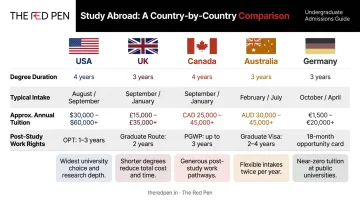
*Most German public universities charge no tuition; semester contributions range from €70–€430 (EUR). Baden-Württemberg is an exception — many non-EU students pay €1,500 per semester (EUR). Always verify with the specific university and state before assuming Germany is free.
The right destination often depends on more than rankings — your Class 12 stream narrows the field considerably.
How Your Class 12 Stream Influences Your Options
Your academic background shapes which countries and courses are the strongest fit:
- Science (PCM/PCB): Strong options in Engineering, Computer Science, and Health Sciences across all five destinations; Germany is particularly cost-effective for STEM
- Commerce: Business Administration, Finance, and Economics programs are widely available in the USA, UK, and Canada
- Arts/Humanities: Social Sciences, International Relations, Design, Media, and Liberal Arts are well-represented at US and UK universities
Most In-Demand Undergraduate Courses
- Engineering and Technology — Available across all five destinations; Germany and Canada offer strong value for PCM students
- Computer Science and AI — Highly competitive admissions; CS graduates in the US and Canada consistently rank among the top-earning fields for international hires
- Business Administration — Flexible entry paths with strong alumni networks in the USA, UK, and Canada; suits Commerce-stream applicants well
- Health Sciences — Structured, competitive entry requirements, particularly in the UK and Australia; early planning is essential
- Design and Media — Strong programs in the USA and UK; portfolio requirements make early preparation critical
Foundation and Pathway Programs
If you don't meet direct entry requirements, foundation programs offer a structured route into a bachelor's degree. These are one-year (or 11-month) bridging courses offered by many universities:
- UK examples: UCL's Undergraduate Preparatory Certificates (one year), University of Manchester's foundation year
- Australia examples: Monash University Foundation Year, UNSW College Foundation Studies
- Canada examples: UBC Vantage One (11-month, credit-bearing), University of Alberta Year One Foundation
These programs are institution-specific — structure, duration, and progression requirements (including minimum passing grades for automatic promotion) differ significantly. Verify directly with each university before applying.
Eligibility Requirements: What Universities Look For
Academic Requirements
International universities accept Indian board certificates — CBSE, ICSE, and state boards — as equivalent to high school qualifications. Approximate minimum percentage thresholds vary by destination:
| Destination | Approximate Minimum (Class 12) |
|---|---|
| UK | 70–80%+ depending on board and university |
| USA | Varies; no national minimum — GPA and course rigor assessed holistically |
| Canada | 75–85% depending on institution and program |
| Australia | 65–75% for most institutions |
| Germany | Typically requires Abitur equivalency; varies by state and course |
Treat these as rough benchmarks. For example, the University of Birmingham lists 70% for ISC, CBSE, Maharashtra, and West Bengal boards — with higher thresholds for competitive programs. Always verify on each university's current course page.
English Proficiency Tests
Most universities accept one of three tests:
- IELTS Academic — Commonly required; typical undergraduate requirement around 6.0–6.5 overall
- TOEFL iBT — Widely accepted in the USA and Canada
- PTE Academic — Accepted at many UK and Australian universities
Loughborough University, for instance, requires IELTS 6.5 overall with 6.0 in each component. Some universities waive proficiency requirements if English was your medium of instruction throughout school — check each institution's policy directly.
Standardised Aptitude Tests
- SAT/ACT — Required by some US universities; many have adopted test-optional policies. Verify each university's current policy, as this changes frequently.
- Subject-specific tests — Oxford uses UAT-UK tests alongside LNAT for Law and UCAT for Medicine from 2026. Requirements vary by course.
Non-Academic Application Components
These components often differentiate strong applications from average ones:
- Statement of Purpose (SOP) / Personal Statement — Your single most important piece of writing; universities use it to assess motivation, self-awareness, and fit for the program
- Letters of Recommendation (LOR) — Should come from subject teachers who can speak to your academic ability with specific examples, not generic praise
- Academic Transcripts — Official Class 10 and 12 records; some universities also request predicted grades for ongoing studies
- CV/Résumé — Highlights extracurricular activities, leadership roles, and any relevant experience beyond academics
Of these, the SOP often requires the most work — and the most revision. The Red Pen's INK (Interactive Narrative Kit) guides students through topic identification, narrative development, and multi-draft writing so the final essay reflects their actual voice and experiences, not a formulaic template.
Step-by-Step Application Process
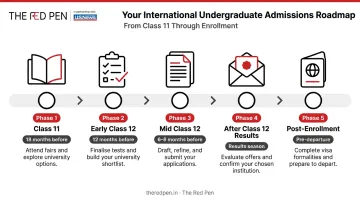
Application Timeline Overview
- Class 11 (18 months before intake): Research destinations, begin test preparation, attend university fairs
- Early Class 12 (12 months before intake): Take English proficiency and aptitude tests, shortlist universities, begin SOP drafting
- Mid Class 12 (6–8 months before intake): Submit applications via UCAS/Common App/direct portals
- After Class 12 results: Meet conditional offer requirements, confirm enrollment
- Post-enrollment: Apply for student visa immediately
Step 1: Research and Shortlist Universities
Build a balanced list across three tiers:
- Reach schools — Where your profile is slightly below the median admitted student but your narrative is strong
- Match schools — Where your grades and profile align well with typical admits
- Safety schools — Where you're highly likely to receive an offer, but still a genuine fit
Factors to consider: course-specific rankings, post-study work policies, scholarship availability, campus culture, and location. Balancing these factors across 10–15 universities takes research and honest self-assessment. The Red Pen's undergraduate admissions consultants conduct detailed profile analyses — covering academics, extracurriculars, budget, and career goals — before building a shortlist tailored to each student.
Step 2: Prepare and Take Standardised Tests
- Begin IELTS/TOEFL/PTE preparation at least 6 months before your application deadline
- Multiple attempts are allowed; most universities consider your highest score
- For SAT/ACT, check whether your target US universities require it or are test-optional
- Register early — popular exam slots fill up quickly
Step 3: Build Application Components
Your SOP and LORs carry more weight than grades for many competitive applicants. The SOP must convey genuine motivation, academic clarity, and a clear connection between your past experiences and future goals. LORs should come from teachers who know your work and can speak specifically to your abilities.
These are crafted narratives, not fill-in-the-blank forms. The Red Pen's essay specialists work through multiple drafts with students, using the INK process to identify the most compelling story angles before a single word is written.
Step 4: Submit Applications via the Right Channels
| Destination | Platform | Notes |
|---|---|---|
| UK | UCAS | Up to 5 choices; deadline-driven cycle |
| USA | Common App | 1,000+ institutions; college-specific deadlines |
| Canada (Ontario) | OUAC | Ontario universities; other provinces use direct applications |
| Australia | Direct / state portals | Varies by university |
| Germany | Direct / uni-assist | University-specific; some require German proficiency |
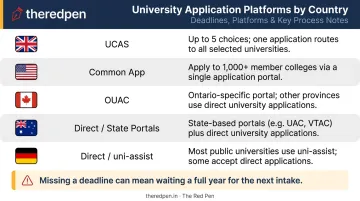
Each platform has its own requirements and deadline structure. Missing a deadline can mean waiting an entire year for the next intake.
Step 5: Respond to Offers and Confirm Enrollment
You may receive conditional or unconditional offers. Conditional offers typically require you to achieve specific Class 12 results. Once conditions are met, confirm enrollment within the specified deadline and pay any required deposit.
Step 6: Apply for a Student Visa
Begin the visa process immediately after enrollment confirmation — do not wait.
| Country | Visa Type | Key Documents |
|---|---|---|
| USA | F-1 | I-20 form, financial proof, SEVIS fee, interview |
| UK | Student Visa | CAS number, passport, financial evidence; typically decided in 3 weeks |
| Canada | Study Permit | Offer letter, funds proof; use IRCC's live calculator for processing times |
| Australia | Subclass 500 | Enrollment confirmation, financial capacity (AUD 29,710 floor as of May 2024), health cover |
US student visas can be issued up to 365 days before study begins, but interview wait times vary by location and season. Apply early.
Financial Planning: Costs, Scholarships, and Loans
Approximate Total Annual Costs (Tuition + Living)
| Country | Estimated Annual Total | Notes |
|---|---|---|
| UK | GBP 11,400–38,000 tuition + GBP 900–1,400/month living | 3-year degree reduces total spend |
| Canada | ~CAD 49,802 tuition (2025/26 avg) + living costs | 4-year degree |
| Germany | Minimal/no tuition at public universities + ~EUR 992/month living (DAAD 2025) | Verify by state |
| Australia | Varies; AUD 29,710 financial capacity floor for visa purposes | Not actual total cost |
| USA | Highly variable by institution; no verified single national figure | 4-year degree |
The UK's 3-year degree structure means total spend is often lower than a 4-year program in the USA or Canada — a factor worth calculating before comparing headline tuition figures.
Scholarships
- University merit scholarships — Apply simultaneously with your university application; deadlines often align
- Government-funded scholarships — For example, the University of Toronto's Lester B. Pearson Scholarship is explicitly for international undergraduate entrants and requires school nomination
- DAAD (Germany) — Offers a database of scholarships, but full bachelor's degree funding is rarely available at the bachelor's level; search specifically for eligible programs
The Red Pen's team has helped students secure over INR 50 crores in scholarships and financial aid in a single admissions cycle. Scholarship eligibility is built into the shortlisting process from day one, so no viable opportunity gets missed.
Education Loans
Education loans are a practical funding option for families who cannot fully self-finance. When evaluating a loan, compare:
- What expenses are covered (tuition, living, travel, insurance)
- Interest rates during the study period vs. after
- Moratorium period and repayment timeline
- Collateral and co-borrower requirements
- Foreign exchange exposure over the loan period
Some Indian banks offer overseas education loan products for full-time foreign courses above INR 20 lakh — but terms vary considerably by product and lender. Compare at least two to three lenders, and pay close attention to forex clauses — these can meaningfully affect your total repayment amount.
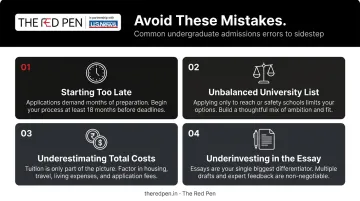
Common Mistakes Indian Students Make When Applying Abroad After 12th
These four mistakes show up repeatedly in unsuccessful applications — and all of them are avoidable with early planning.
Starting too late. Most students begin serious research only in Class 12, leaving no buffer for test preparation, SOP writing, or application deadlines. Start at the beginning of Class 11 — at least 18 months before your intended intake.
An unbalanced university list. Applying only to highly selective institutions risks receiving no offers. Applying only to less competitive ones undersells your profile. Build a deliberate mix: 2–3 reach schools, 3–4 match schools, and 2 safety schools where your profile is comfortably above the median.
Underestimating total costs. Tuition is one number — not the whole picture. Your actual budget needs to account for:
- Housing and food
- Health insurance
- Travel (to and from India)
- Visa fees and living expenses
Costs vary significantly by location. London and New York run considerably higher than smaller university towns in Canada or Germany.
Underinvesting in the essay. Strong grades open the door. A generic, achievement-listing personal statement closes it. Admissions officers read thousands of essays — the ones that stand out tell a specific, honest story rather than summarise a résumé.
Frequently Asked Questions
How much does it cost to study abroad after 12th?
Total annual costs (tuition + living) range broadly — from minimal fees in Germany to GBP 25,000–50,000+ in the UK or equivalent figures in the USA. Canada averages around CAD 49,802 in tuition alone for 2025/26. Scholarships and loans can reduce the out-of-pocket burden considerably.
Can I study abroad after 12th for free?
Fully free education is rare, but Germany's public universities charge little to no tuition (semester contributions of EUR 70–430, with exceptions in Baden-Württemberg). Many universities globally also offer merit scholarships covering partial or full costs — strong academics and early applications improve your eligibility.
Which course is best after 12th for going abroad?
There's no single answer — it depends on your stream and career goals. That said, Engineering, Computer Science, Business Administration, and Health Sciences consistently offer strong global career prospects and wide university availability across the USA, UK, Canada, and Australia.
Which country is best for study after 12th?
No single country is best for every student. The USA offers the widest course variety; the UK's 3-year degrees reduce total cost; Canada and Australia offer strong post-study work pathways; Germany suits cost-conscious STEM students.
What is the minimum percentage required to study abroad after 12th?
Most universities look for 60–80% in Class 12, with selective institutions expecting 85% or higher. Requirements vary by country, university, board, and programme — verify directly with each institution rather than relying on general benchmarks.
How early should I start preparing to study abroad after 12th?
Start in Class 11 — at least 18 months before your intended intake. This gives you time for test preparation, university research, SOP drafting, and scholarship applications without rushing any component. Students who begin in Class 12 often find themselves scrambling against deadlines.