Introduction
Choosing to study abroad after Class 10 is one of the earliest — and most consequential — academic decisions a student can make. At 15 or 16, committing to international education means building your entire senior school profile on a globally recognised curriculum, years before most Indian students start thinking about undergraduate applications.
The numbers reflect this growing appetite. In 2025, 2,011 Indian pupils were enrolled in UK independent schools alone, according to the ISC Census — a figure that represents just one destination. Families across India are weighing international high school options for their children, drawn by curricula like the IB Diploma and A-Levels and the long-term academic advantages they offer.
This guide covers everything you need to make an informed decision: the best countries for Indian students, eligibility requirements, available scholarships, program types, and a realistic application timeline.
Key Takeaways
- Top destinations: USA, UK, Canada, Australia, and Germany
- Available programs: IB Diploma, A-Levels, High School Diploma (AP), and Foundation Courses
- Typical academic eligibility: Strong performance in Classes 9–10; requirements vary by school
- English proficiency: IELTS 5.5–6.0 for most school-level programs (school-specific)
- Scholarship types: Fully funded (UWC, YES Program) and merit-based awards from individual schools
Why Indian Students Are Choosing to Study Abroad After 10th
The Early Entry Advantage
Completing high school on an internationally recognised curriculum (IB Diploma, A-Levels, or Advanced Placement) reshapes your entire undergraduate application profile. When a student applies to US, UK, or Canadian universities with two years of IB or A-Level study on their transcript, admissions offices can evaluate them on a framework they already understand and trust.
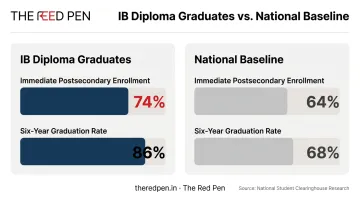
Research from the National Student Clearinghouse found that US IB Diploma graduates had a 74% immediate postsecondary enrolment rate and 86% six-year graduation rate, compared to 64% and 68% for national baselines. The authors caution against reading this as direct causation, but for Indian students building competitive undergraduate applications, the pattern is hard to ignore.
A Different Kind of Learning
International curricula are built around inquiry, independent research, and written argumentation — skills that most Indian boards introduce primarily in the undergraduate years. Students who spend Grades 11–12 writing extended essays, conducting internal assessments, and engaging in collaborative projects arrive at university already comfortable with the academic demands they'll face.
Cambridge International's research on active learning contrasts inquiry- and problem-based approaches with passive instruction — the kind of shift students experience when moving from an Indian board environment to an IB or A-Level school. That academic adjustment, made during high school rather than first year of university, has real consequences for how students perform once they arrive.
Career and Pathway Considerations
One important caveat: completing high school abroad does not by itself qualify students for post-study work visas in Canada or Australia. Both the Canadian PGWP and the Australian subclass 485 require qualifying postsecondary study. The real advantages of studying abroad after 10th are academic and developmental:
- Stronger undergraduate applications through internationally recognised curricula
- Adaptation to independent, inquiry-based learning before university begins
- A global peer network built during formative high school years
Eligibility Requirements to Study Abroad After 10th from India
Eligibility criteria differ by country, school, and programme — so rather than chasing a single benchmark percentage, focus on what each destination actually evaluates.
Academic and Age Requirements
| Requirement | What to Expect |
|---|---|
| Prior grades | Strong performance in Classes 9–10 across core subjects |
| Age at entry | Typically 15–17 years; some programs require 16+ |
| Eligible pathways | Grades 11–12, IB Diploma, A-Levels, Foundation Programs, Vocational courses |
| Documentation | Transcripts, mark sheets, school certificates |
Some selective institutions and scholarship programs (like UWC) have specific birth-date windows and apply competitive academic thresholds — check each school's requirements individually rather than relying on a general percentage.
English Language Requirements
Once you meet the academic threshold, most English-medium destinations will ask for proof of English proficiency. Real requirements from specific schools include:
- IELTS 5.5 — SFX Sixth Form College (UK)
- IELTS 6.0, no band below 6.0 — NSW Department of Education International (Australia)
- UKiset or internal testing — Westminster School (UK)
Some schools conduct their own assessments rather than using standardised tests. Always check the specific school's requirements, as there is no single global standard.
Financial and Supporting Documents
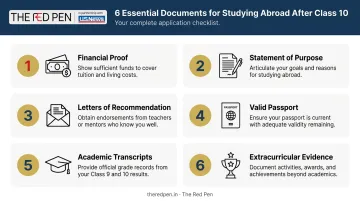
Alongside your academic and language documents, every application needs a financial and supporting file. Plan to gather:
- Financial proof: Bank statements, education loan letters, or sponsor declarations — sufficient to cover at least one full year of tuition and living costs
- Statement of Purpose (SOP): A written statement covering your academic goals, chosen programme, and reasons for studying in that country
- Letters of Recommendation (LORs): Usually 1–2 letters from subject teachers who can speak to your academic ability and character
- Valid passport
- Extracurricular evidence: Records of awards, leadership roles, sports, or arts participation — especially important if you are applying for merit scholarships
Best Countries to Study Abroad After 10th for Indian Students
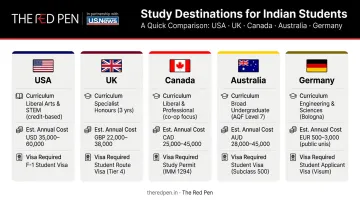
The right country depends on your budget, preferred curriculum, comfort with the language, and long-term career goals. Each destination below offers a different combination of costs, qualifications, and pathways — understanding these differences before committing can save families significant time and money.
USA
The US offers the most curriculum flexibility: Advanced Placement (AP), IB Diploma, and a standard high school diploma are all available depending on the school. Private boarding schools emphasise the whole-student profile — leadership, community service, and extracurricular depth matter alongside academics.
Cost benchmark: Top private boarding schools (Exeter, Andover) charge US$71,797–US$79,800 for 2026–27, before additional expenses. More affordable private boarding options exist well below this range.
Visa required: F-1 student visa. Note that F-1 students at US public high schools are limited to 12 months and must pay full unsubsidised costs.
UK
UK independent schools offer a direct two-year pathway through A-Levels or the IB Diploma into undergraduate programs at universities worldwide. Cambridge A-Levels are accepted by thousands of universities globally.
Cost benchmark: Malvern College's 2025–26 non-UK sixth-form boarding fee is £20,560 per term (approximately £61,680 per year), with additional specified charges.
Visa required: Child Student visa for students under 18; students 16+ may qualify for the Student route depending on the school's sponsor conditions.
Canada
Canada's provincial Grade 11–12 diplomas (such as Ontario's OSSD) are well-recognised and public board tuition is comparatively affordable. The learning environment tends toward smaller class sizes and practical application.
Cost benchmark: TDSB and Vancouver School Board charge C$17,000 annually for public board tuition. Private boarding schools (Pickering College, Upper Canada College) range from C$87,500–C$89,570 for 2026–27.
Visa required: Study Permit. Students under 17 must travel with a parent or have a designated Canadian custodian.
Australia
Australia's Senior Secondary (Years 11–12) program includes options for VET (Vocational Education and Training) and school-based apprenticeships alongside traditional academic streams — making it particularly suitable for students who want practical, skills-based qualifications.
Cost benchmark: NSW Years 11–12 tuition is A$20,500; Northern Territory senior secondary tuition is A$14,400, with homestay adding approximately A$348 per week where applicable.
Visa required: Student visa subclass 500, with specific under-18 welfare and guardian arrangements.
Germany and Europe
German state schools are largely free, though this primarily applies to children residing in Germany — it is not an open international boarding product for Indian minors. Ausbildung (vocational training) follows an earn-while-you-learn model, but requires a confirmed training place, a recognised school certificate, and typically B1 German proficiency.
France and the Netherlands offer lower tuition than English-speaking destinations, but access depends on meeting language and residence requirements first. For families who can satisfy those conditions, both are genuinely cost-effective options worth considering.
Top Scholarships to Study Abroad After 10th from India
Fully funded scholarships for pre-university students are competitive and limited. Partial merit-based awards from individual schools are more widely available. Apply 10–12 months before intake — scholarship deadlines frequently close well before the academic year begins.
United World Colleges (UWC) Scholarship
UWC is one of the most prestigious scholarship programs available to Indian students aged 16–17. It operates across 18 schools on four continents, all offering the IB Diploma.
A full award covers tuition, room, board, books, and core school costs. All-inclusive awards extend to return flights, visa fees, and a monthly stipend.
For 2027 entry, applicants must be in Grade 10 or 11, meet the published birth-date window, and hold Indian nationality or OCI/PIO status. Selection involves essays, recommendations, interviews, and a financial assessment — apply through the UWC India National Committee.
YES Program (USA) and Exchange Programs
The Kennedy-Lugar Youth Exchange and Study (YES) Program is a fully funded US government exchange for students from eligible countries including India. Benefits include round-trip travel, host-family placement, school enrolment, insurance, and a monthly stipend.
Eligible applicants are aged 15–17.7, in Grades 8–11, and hold Indian citizenship or residency. Check YES Programs India for current application windows, as cycles open and close on specific dates.
Other exchange programs worth exploring:
- AFS India — partial to full scholarships available for eligible candidates
- ASSIST Scholars — primarily targets students aged 14–18 in Grades 9–10; the Sanderson award covers tuition, room, and board (families typically retain auxiliary costs)
School-Based Merit Scholarships
Many private schools in the UK, Canada, and Australia offer merit scholarships based on academic performance, entrance test scores, and extracurricular achievement. These typically provide 10%–50% tuition reduction rather than full funding.
Millfield School (UK) publishes awards carrying up to a 10% fee reduction for international students — availability is limited, so check individual school websites and apply early.
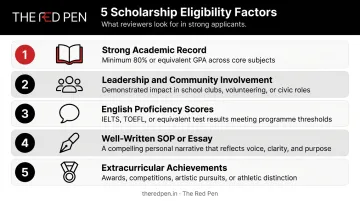
Common Eligibility Factors Across Scholarships
- Strong academic record (generally 80%+ aggregate, with consistency across subjects)
- Demonstrated leadership or community involvement
- English proficiency scores (school-specific thresholds)
- A well-written SOP or application essay
- Extracurricular achievements — sports, arts, or academic competitions strengthen applications
How to Apply: A Step-by-Step Timeline
12–18 Month Preparation Window
| Timeline | Action |
|---|---|
| 12–18 months out | Research countries, curricula, and school options; attend boarding school fairs |
| 10–12 months out | Take English proficiency tests (IELTS/TOEFL); gather transcripts and documents |
| 6–8 months out | Shortlist 5–7 schools; prepare SOPs and LORs; submit applications |
| 3–4 months out | Apply for relevant student visa after receiving offer letter |
| 1–2 months out | Arrange accommodation, health insurance, travel, and forex |
Scholarship deadlines are typically the earliest in the cycle, so confirm those dates first and work your preparation timeline backward from there.
Application Components
A competitive application typically includes:
- A school list of 5–7 options spread across dream, target, and safety tiers
- A tailored SOP or personal statement for each school's specific prompt
- Letters of recommendation from 1–2 teachers with strong academic knowledge of you
- English proficiency scores, or readiness for the school's own language assessment
- Prepared responses for school interviews, practised through mock sessions in advance
The Red Pen's education counselling team helps students and parents work through school selection, application strategy, and essay preparation — bringing structured, personalised guidance to every stage of this process.
Visa and Pre-Departure Steps
After receiving your offer letter:
- Apply for the relevant visa (F-1 for USA, Child Student visa for UK, Study Permit for Canada, subclass 500 for Australia)
- Provide financial proof, admission documents, and medical records
- Arrange boarding or homestay accommodation and confirm guardian arrangements if under 17 (Canada) or under 18 (Australia)
- Sort health insurance, travel, and forex before departure
Key Challenges and How to Plan Around Them
Emotional and Social Adjustment
Students aged 15–17 are navigating identity formation and peer relationships at the same time they're managing a new country, curriculum, and living situation. Homesickness and culture shock are real — most acute in the first semester.
OECD research links stronger school belonging with reduced loneliness and easier friendship formation among adolescents. When selecting a school, ask specifically about:
- Pastoral care and house parent systems
- Access to school counsellors and mental health support
- Indian or South Asian student communities
- Peer mentoring programs for new international students
Financial Planning Beyond Tuition
Tuition is only part of the annual cost. Families must budget for:
- Accommodation (homestay or boarding)
- Return flights (1–2 per year)
- Health insurance (often mandatory for student visas)
- Personal expenses, food, and activities
- Forex and money transfer costs
Compare the total cost of attendance, not just the tuition figure. The gap between headline tuition and actual annual spend can be substantial — especially at private boarding schools where extras (uniforms, activities, exam fees) are billed separately.
Academic Adjustment
Beyond finances, the academic shift itself catches many students off guard. IB and A-Level programs demand independent thinking, research, and written argumentation that most Indian board students haven't encountered systematically.
Before departure, students should practise:
- Extended essay writing and argumentation
- Independent reading beyond the syllabus
- Self-directed study and time management without daily parental supervision
Students who arrive having practised these skills tend to find their footing faster — those who don't often spend the first term catching up on process, not content.
Frequently Asked Questions
Which countries are best to study abroad after 10th?
The top destinations for Indian students are the USA, UK, Canada, Australia, and Germany. The USA is known for curriculum flexibility; the UK offers a direct A-Level or IB route; Canada combines affordable tuition with immigration-friendly policies; Australia covers both academic and vocational tracks; Germany suits students willing to meet language requirements for lower-cost education.
Which countries allow students to study abroad after 10th?
Most major study destinations allow Indian students to enrol in high school or pre-university programmes after Class 10. Each country sets its own conditions around minimum age, academic records, English proficiency scores, and student visa eligibility.
Can I get a 100% scholarship to study abroad after 10th?
Fully funded options exist — the UWC scholarship and the YES Program are the best-known — but both are highly competitive. In practice, most students combine partial merit awards from individual schools with education loans or family savings.
What is the minimum percentage required in Class 10 to study abroad?
There is no single universal cutoff. Schools set their own requirements based on prior grades, entrance tests, and interviews. Competitive schools and scholarship programs typically expect 80%–90%+, while others assess candidates more holistically. Consistency across subjects and a strong upward trend matter as much as the aggregate score.
What programs can Indian students pursue after 10th grade abroad?
The main pathways include: IB Diploma, A-Levels (UK), Advanced Placement and High School Diploma (USA), Senior Secondary Years 11–12 (Australia), Foundation Programs (various countries), and Vocational/Technical training through Ausbildung (Germany) or VET (Australia).
What are the biggest challenges of studying abroad after 10th?
Three challenges stand out for most students making this move:
- Emotional adjustment: Living away from family at 15–17 brings homesickness that many underestimate.
- True cost of attendance: Total annual expenses regularly exceed the advertised tuition figure.
- Academic transition: Overseas schools expect independent, research-oriented learning — a significant shift from Indian board patterns.